Azure Lakehouse
Data Pipeline
An end-to-end Azure lakehouse turning 81K raw FPT Play OTT search-log records into a star-schema warehouse — with Auto Loader incremental ingestion, ML-based Vietnamese keyword normalization, a Synapse serving layer, Superset dashboards, and Grafana pipeline monitoring.
Tech stack
 Azure
Azure
 Databricks
 Delta Lake
 Synapse
 Superset
 Grafana
 Prometheus
 Docker
 Python
The problem
FPT Play produces raw OTT search logs — each event a user_id × keyword × platform × network × subscription record. The keywords are messy: typos, missing Vietnamese diacritics, and noise ("doremon", "nguoi nhen", "one pice"), making it impossible to answer "which titles are actually being searched for?" without cleaning them first.
The goal: port an AWS lakehouse design to Azure, build an incremental Bronze → Silver → Gold pipeline, normalize search keywords to canonical movie titles with ML, and serve analytics through a warehouse and BI dashboards — with pipeline observability on top.
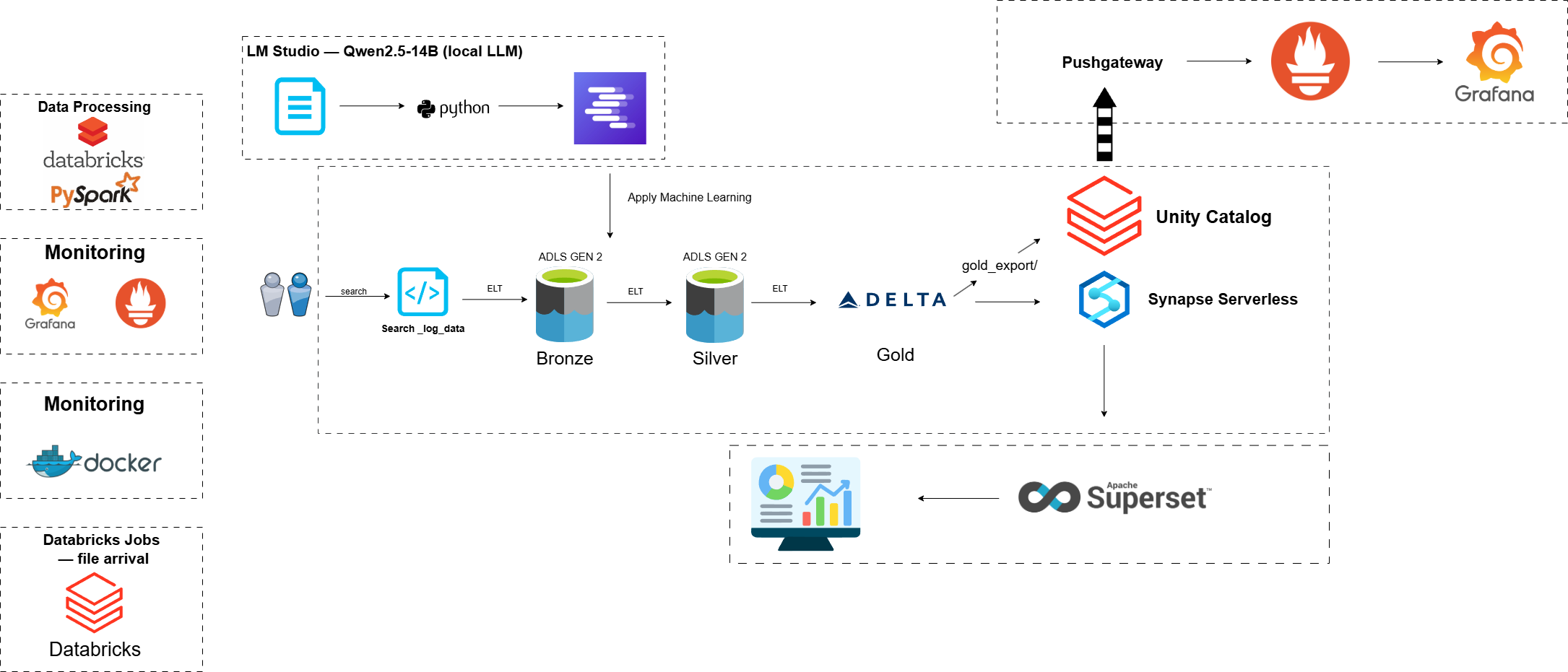
System architecture — Azure cloud pipeline plus the local Docker analytics & monitoring stack.
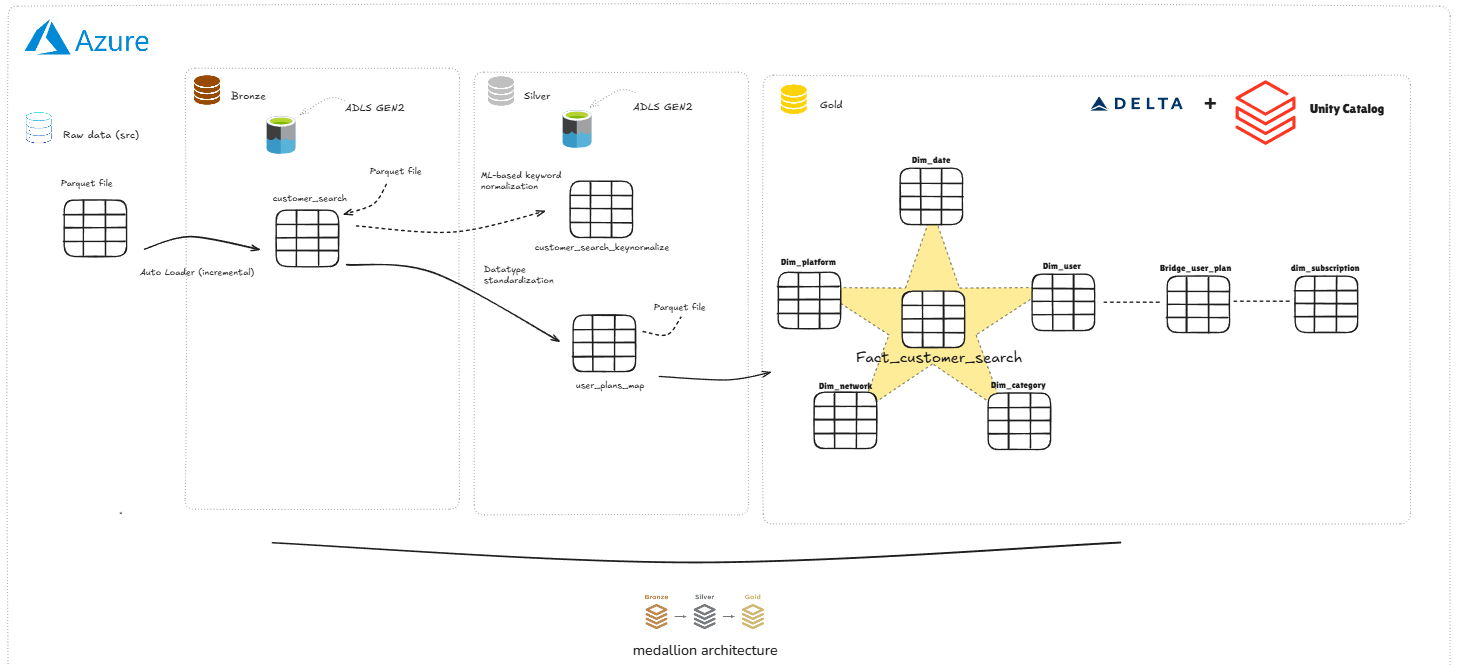
Detailed medallion flow, ending in the Gold star schema.
Data model
81K search events land as Parquet in ADLS Gen2 and flow through three Delta Lake layers — Bronze, Silver, Gold — governed by Unity Catalog. Gold is exported to a plain ADLS path and served by Synapse Serverless SQL for BI.
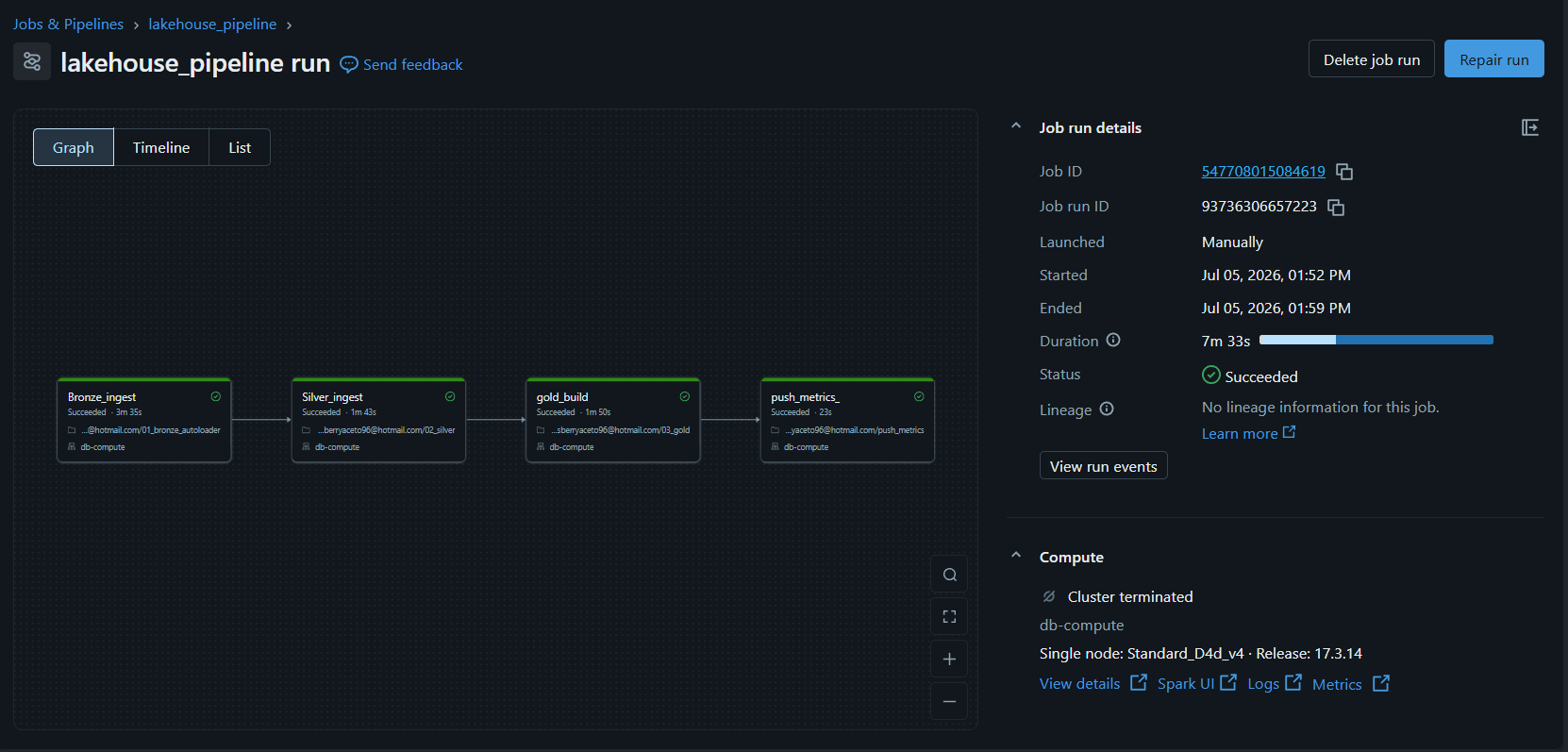
The lakehouse_pipeline Databricks Job — four chained notebook tasks, fired on file arrival, all green.
| Table | Rows | Description | Layer |
|---|---|---|---|
bronze.customer_search |
81,483 | Raw search events, Auto Loader incremental append, minimal typing | Bronze |
silver.customer_search_keynormalize |
81,469 | Cleaned dates & fields, keywords normalized to canonical titles via ML MERGE | Silver |
silver.user_plans_map |
14,778 | Exploded userPlansMap array into plan_name / plan_source rows | Silver |
gold.fact_customer_search |
81,469 | Central fact — surrogate keys to 5 dimensions, plus hour_of_day | Gold |
gold.bridge_user_plan |
8,437 | Resolves the many-to-many between users and subscriptions | Gold |
gold_export/ + Synapse views |
— | Plain Delta export queried in place by Synapse OPENROWSET, read by Superset | Serving |
Plus six dimensions — dim_date, dim_platform, dim_category, dim_network, dim_user (SCD Type 1), and dim_subscription — completing the star schema.
What the data actually looks like at each step
Raw → Bronze Ingested as-is; only datetime typed (two locale formats reconciled)
| keyword | platform | networkType | proxy_isp | action |
|---|---|---|---|---|
| doremon | smarttv-sony-android | wifi | fpt | search |
| lưu ly mỹ nhân sát | ios | WIFI | vnpt | search |
| one pice | android | wifi | viettel | search |
Bronze → Silver Keyword normalized to canonical title with a match method & confidence
| keyword | keyword_normalized | _kw_match_score | _kw_match_method |
|---|---|---|---|
| doremon | Doraemon | 1.0 | llm_fuzzy_clustered |
| one pice | One Piece | 0.95 | llm_fuzzy_clustered |
| vượt bguc | Vượt Ngục | 0.89 | rapidfuzz |
Silver → Gold Facts join surrogate keys; dimensions carry descriptive attributes
| eventID | date_key | hour_of_day | platform_key | keyword_normalized |
|---|---|---|---|---|
| 0afcf316… | 20220602 | 17 | 21 | Doraemon |
| e3f53aef… | 20220602 | 14 | 8 | One Piece |
Data-quality challenges encountered
Cast to TIMESTAMP failed — two datetime formats in one column
The source mixed 24-hour strings with Vietnamese-locale 12-hour values carrying SA/CH (AM/PM) suffixes. Fixed by regexp-substituting the suffixes then coalesce(try_to_timestamp(24h), try_to_timestamp(12h)).
Timestamps in year 2565 — Buddhist-Era calendar
108 rows landed 543 years in the future (Thai BE calendar). Corrected with add_months(-543*12) in Silver; 14 truly unparseable rows are dropped and show as the Bronze→Silver delta on the Grafana dashboard.
Vietnamese rendered as "?" in Superset
Hours were spent chasing a pymssql/FreeTDS driver bug. The real cause: Synapse's default CP1252 collation can't hold characters like ầ/ồ/ữ. Fixed with ALTER DATABASE gold_db COLLATE Latin1_General_100_BIN2_UTF8.
ML keyword normalization
The core challenge: map messy search keywords to canonical movie titles. A local LLM classifies high-frequency keywords, then fuzzy matching handles the long tail — all applied to Silver via an idempotent MERGE.
- Pareto scoping — keywords with freq ≥ 2 (7,646 unique) cover ~72% of traffic; the 21K freq=1 long-tail is handled with cheap fuzzy matching instead of the LLM
- Local LLM — Qwen2.5-14B via LM Studio (JSON-schema output, 4 worker threads) labels each keyword: movie or not, canonical title, confidence
- Confidence calibration — a hand-reviewed sample showed the model is not well-calibrated (weighted fit R²=0.405); accuracy at conf 0.85 was 17.4% vs 65.3% at ≥0.95, so only ≥0.95 mappings are trusted
- Fuzzy clustering — rapidfuzz (threshold 92, sequel-protection rules) merges near-duplicate titles: 3,173 → 3,006
| Match method | Rows | Meaning |
|---|---|---|
| llm_fuzzy_clustered | 30,703 | LLM-confirmed movie, conf ≥ 0.95, clustered |
| rapidfuzz | ~1,445 | Long-tail fuzzy-matched to a confirmed title |
| llm_not_movie | 20,867 | Not a movie title — channels, apps, noise |
| low_confidence | 1,292 | Suspected movie, conf < 0.95 — kept raw |
| raw | 27,162 | Remaining long-tail, left as-is (demo scope) |
Raw LLM accuracy was only 40.4% — the honest number is what drove the strict 0.95 threshold instead of blindly trusting model confidence.
Approach
Five notebooks move data one layer at a time, wired into a Databricks Job that fires on file arrival. Transforms run in PySpark; Unity Catalog governs access; Auto Loader handles incremental ingestion.
Step 1 — Incremental ingest (Auto Loader)
Bronze uses cloudFiles with trigger(availableNow=True). A checkpoint tracks which files were processed, so only new files are read and re-running the notebook never duplicates rows — batch economics with streaming plumbing.
- Exactly-once — the checkpoint guarantees each file is ingested once, no manual offset tracking
- No small-files problem — Spark controls output file sizes rather than hand-chunking rows into tiny Parquet files
- Event-driven — a Databricks Job with a file-arrival trigger runs the whole chain when a new batch lands
Step 2 — Transform, normalize & model
Silver fixes calendars/locales, lowercases fields, and applies the ML mapping via MERGE. Gold builds a star schema: a central fact plus six dimensions and a bridge table for the user↔subscription many-to-many.
| Relationship | How it's modeled |
|---|---|
| fact → 5 dims | date / platform / category / network / user joined by surrogate keys |
| user ↔ subscription | many-to-many resolved through bridge_user_plan (not joined straight to the fact) |
| dim_user | SCD Type 1 — dataset spans 3 days; Type 2 is the documented evolution path |
Where Unity Catalog & Synapse fit in
Unity Catalog is not on the data path. Delta files live on ADLS Gen2; Unity Catalog is the governance layer that tracks each table's location, schema, and access via a Managed Identity. Synapse Serverless holds no data either — it queries the exported Delta files in place through OPENROWSET, billed per TB scanned, keeping BI queries off the pipeline's compute.
📚 ADLS is the bookshelf holding the actual files; Unity Catalog is the card catalog; Synapse is a reading desk that opens the books in place without copying them.
Key techniques used
readStream.format("cloudFiles")
Auto Loader with availableNow trigger — incremental, exactly-once file ingestion that terminates like a batch job.
MERGE INTO ... WHEN MATCHED
Idempotent application of the ML keyword mapping keyed on keyword + method='raw', safe to re-run.
rapidfuzz UDF + diacritic strip
Long-tail matching with Vietnamese diacritic normalization and a min-length ≥ 6 guard to stop short keywords matching nonsense.
OPENROWSET(FORMAT='DELTA')
Synapse Serverless views read the exported Delta tables in place — no data copy, pay-per-scan serving.
Pushgateway ← ngrok ← Databricks
Row-count metrics pushed from the cloud through a tunnel to a local Prometheus, visualized in Grafana as pipeline observability.
Dashboards & monitoring
A Superset dashboard for analytics, connected to Synapse, plus a Grafana dashboard for pipeline observability fed from Databricks.
| Tool | Focus | Key visuals |
|---|---|---|
| Superset | OTT search analytics | Top 20 movies · searches by hour (prime-time peak 20–21h) · match-method pie · device type · ISP · subscription plans · movie keyword cloud |
| Grafana | Pipeline observability | Per-table row counts by layer · total 302,794 rows · the 14-row Bronze→Silver drop visible at a glance |
Screenshots
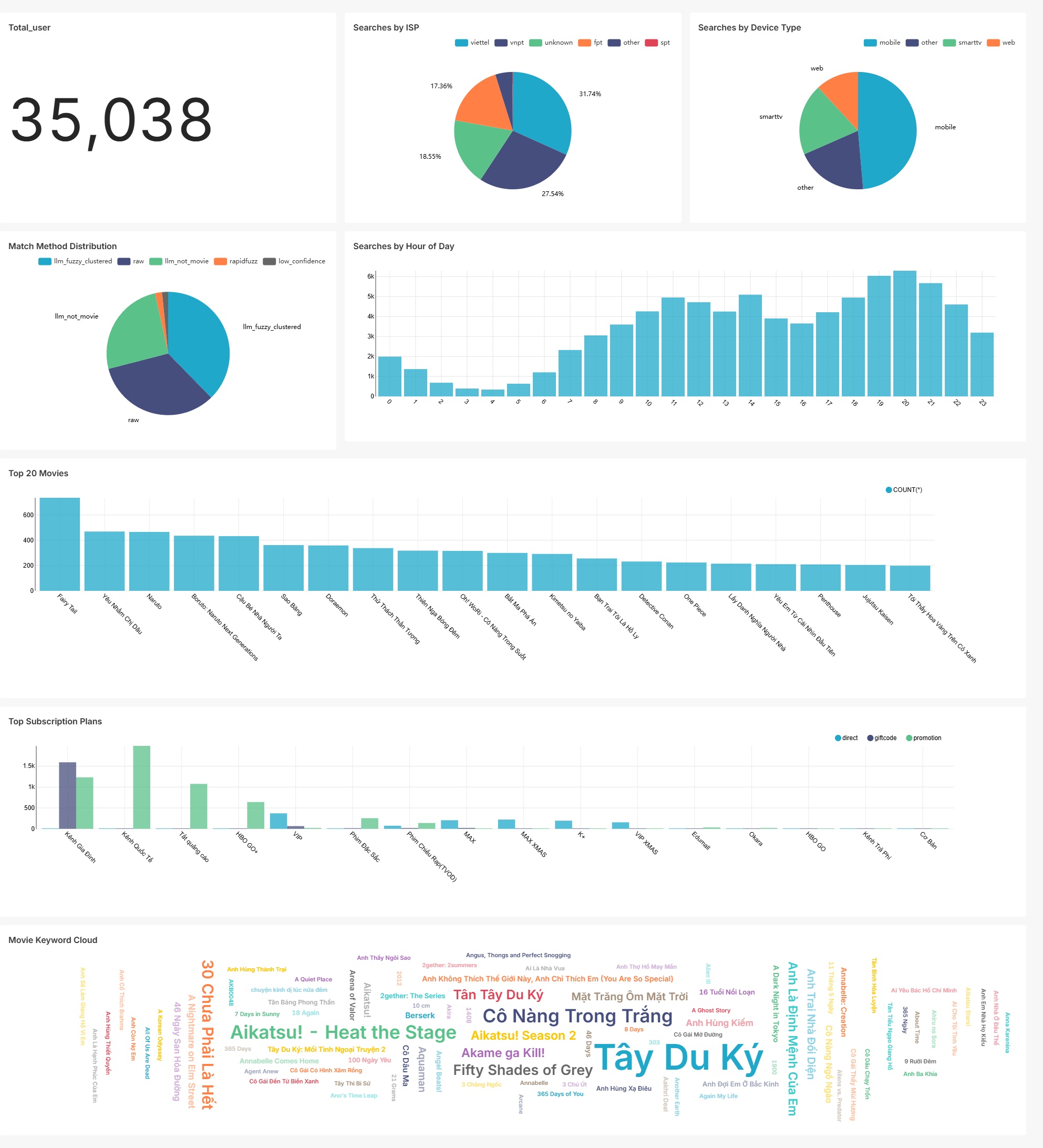
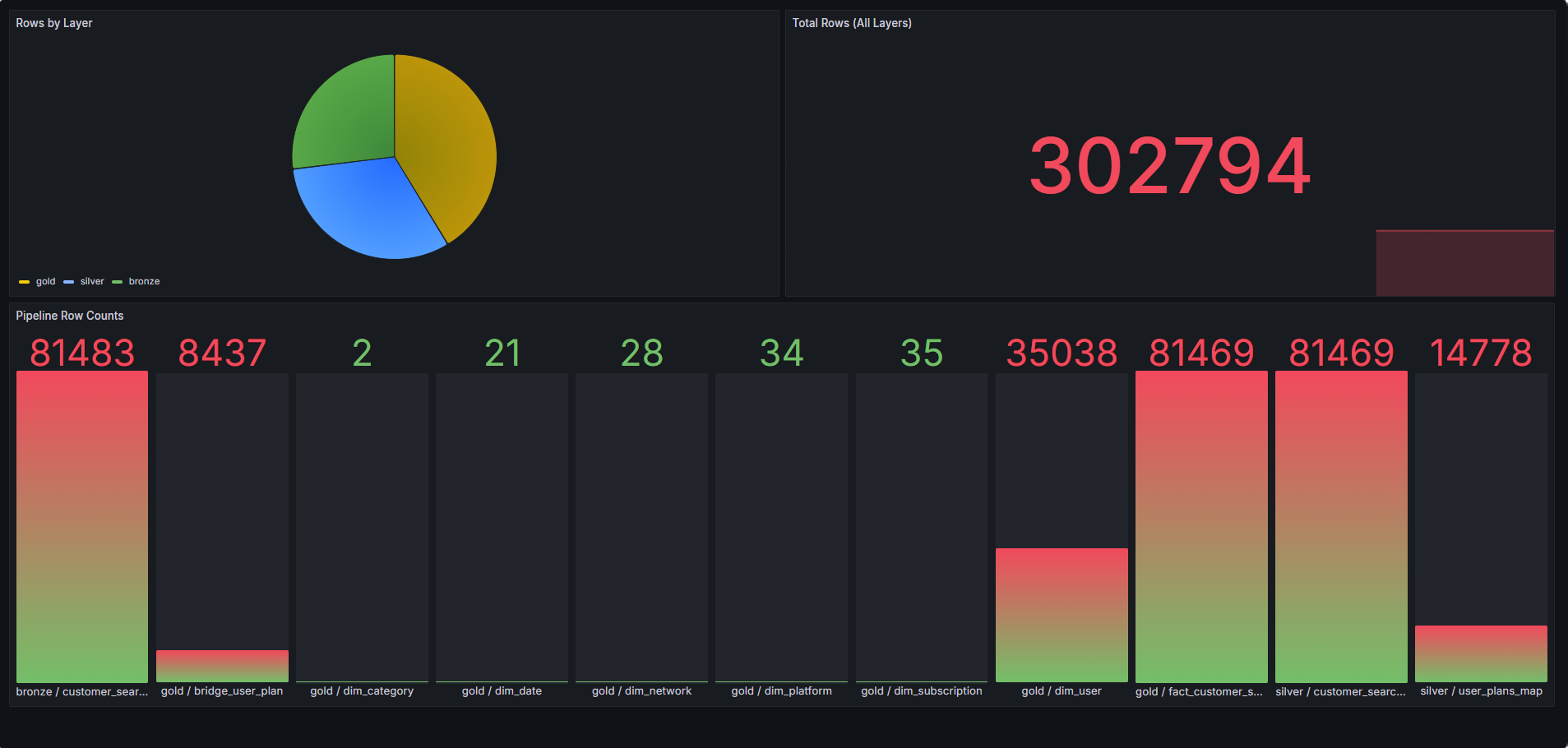
Superset analytics (top) and Grafana pipeline monitoring (bottom).
Results
What I'd do differently
Process the full long-tail — the demo ran rapidfuzz on 4K of the 27K remaining raw keywords; a complete pass would push normalization coverage well past 72%.
Add a dim_movie dimension instead of keeping the normalized title as a degenerate attribute on the fact — cleaner for title-level slicing and future enrichment (genre, release year).
Replace the ngrok tunnel with a Pushgateway on Azure Container Instances inside the same VNet — the honest production answer to "how does a cloud job reach a home PC behind CGNAT."
- SCD Type 2 on dim_user — once multi-week history exists, track profile changes over time instead of overwriting
- Data-quality gates — Delta constraints between layers with Grafana alerting when row counts drift unexpectedly
- CI/CD for notebooks — Databricks Asset Bundles; Terraform IaC is demonstrated in my separate CI/CD project